THOUSANDS OF FREE BLOGGER TEMPLATES �
Showing posts with label Game Play. Show all posts

Thursday, June 11, 2009

- Doubles game -


In addition to games between individual players, pairs may also play table tennis. In doubles, all the rules of single play apply except for the following. A line painted along the long axis of the table to create doubles courts bisects the table. This line's only purpose is to facilitate the doubles service rule, which is that service, must originate from the right hand "box" in such a way that the first bounce of the serve bounces once in said right hand box and then must bounce at least once in the opponent side's right hand box (far left box for server). Play then continues normally with the exception that players must alternate hitting the ball. For example, after a player serves, the receiving player makes his or her return, the server's partner returns the ball and then the service receiver's partner would play the ball.
The point proceeds this way until one side fails to make a legal return and the point is then awarded to the other team. Also, when the game reaches the final set, the teams must switch side and the team that receives the service must switch receiver when one of the teams reach 5 points. Singles and doubles are both played in international competition, including the Olympic Games since 1988 and the Commonwealth Games since 2002. In 2005, the ITTF announced that doubles table tennis will only be featured as a part of teams events in the 2008 Olympics.
source: wikipedia.org


- Series of games -


After each game, players switch sides of the table and in the fifth or seventh, game "for the match", players switch sides when the first player scores 5 points, regardless of whose turn it is to serve. In competition play, matches are typically best of five or seven games. When one player has reached "game point", meaning one player has 20 points while the other has 19 or less, the losing player cannot lose on a faulty serve. once the game is tied standard rules apply.


source: Wikipedia.org

- Alternation of service -


Service alternates between opponents every two points (regardless of winner of the rally) until a player reaches 11 points with at least a two-point lead, or until both players have 10 points a piece. If both players reach 10 points, then service alternates after each point, until one player gains a two-point advantage. This is the currently used standard followed by the ITTF.


In doubles, service alternates every two points between sides, but also rotates between players on the same team. At the end of every two points, the receiving player becomes the server, and the partner of the serving player becomes the receiver.


In the 21-point game system, service would alternate every 5 points. If both players reached a score of 20, then service would alternate each point until one player gains a two-point advantage.
source: wikipedia.org

- Scoring -


Points are awarded to the opponent for any of several errors in play:


  • Allowing the ball to bounce on one's own side more than once.

  • Double hitting the ball. Note that the hand below the wrist is considered part of the racket and making a good return off one's hand or fingers on the racket-holding hand is allowed, but hitting one's hand or fingers and subsequently hitting the racket is a double strike and an error.

  • Allowing the ball to strike anything other than the racket (see above for definition of the racket)

  • Causing the ball not to bounce on the opponent's half (i.e., not making a "good" return)
    Placing one's free hand on the playing surface or moving the playing surface
    Offering and failing to make a good serve (i.e., making a service toss and failing to strike the ball fairly into play)

  • Making an illegal serve: (e.g., one preceded by a player's hiding the ball or his failing to toss the ball at least 16 centimeters (six inches) in the air).

  • Hitting the net with racket or any body part.

  • By volleying the ball (not allowing the ball to bounce on your side)

source: wikipedia.org

- Hitting the ball -


Any hitting of the ball must be done such that the ball passes over or around the net. If the ball is struck such that it travels around the net, but still lands on the opponent's side of the table, the hit is legal and play should be continued. If a player cannot return a legal hit over (or around) the net so that the ball bounces on the opposite side of the table, the player loses the point.
source:wikipedia.org

- Service -


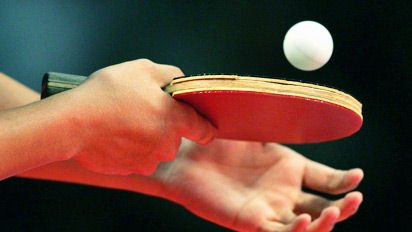
In game play, the player serving the ball commences a point. Standing so that the ball is held behind the endline of the table, with the ball in the palm of the free hand—over the table's height—and the racket in the other, the server tosses the ball without spin, upward, at least 16 centimeters (approximately 6 inches). In casual (non-tournament) games, many players do not toss the ball upward, however this is technically illegal and can give the serving player an unfair advantage. The ball must remain above the height of the table at all times. The server cannot use his body or clothing to obstruct sight of the ball; the opponent and the umpire must have a clear view of the ball at all times


He or she then must hit the ball from behind the baseline such that it bounces once on his or her half of the table, and then bounces at least one time on the opponent's half. If the ball strikes the net but does not strike the opponent's half of the table, then a point is awarded to the opponent. However, if the ball hits the net, but nevertheless goes over and bounces on the other side, it is called a let (or net-in). Play stops, and the ball must be served again with no penalty. A player may commit any number of lets without penalty.


If the service is "good", then the opponent must then make a "good" return—by returning the ball before it bounces on his or her side of the table a second time. Returning the serve is one of the most difficult parts of the game, as the server's first move is often the least predictable—due to the numerous spin choices at his or her disposal—and thus most advantageous to him or her.


source: wikipedia.org

- Starting The Game -


In top-flight competition, service is decided by a coin toss. At lower levels it is common for one player (or the umpire/scorer) to hide the ball in one or the other hand (usually hidden under the table), allowing the other player to guess which hand the ball is in. The correct or incorrect guess gives the "winner" the option to choose to serve, receive, or to choose which side of the table to use. Another method is for one player to hit the ball to the other and he or she returns it or by hitting it back and forth four times and then playing out the point. This is commonly referred to as "volley to serve". Then, they play one point to see who serves first. Players also determine the first to serve by placing a racket on the table with the handle off the board, taking turns throwing the ball at their opponent's racket. The first to strike the opponent's racket without receiving a return shot gets the serve.
source: wikipedia.org